PILOT DISCUSSIONS FOR LOT-LEVEL TRACEABILITY

Every lot has a story. AgriSense makes it readable.

By connecting farm-level evidence, lot history, and real-time transit tracking into clear digital produce passports, AgriSense bridges the trust gap between smallholder farmers and premium buyers to eliminate buyer risk, cut post-harvest loss, and accelerate trade.

Bring each handoff into view—from farm and pack house to the buyer’s review—so the history of a lot remains useful as it moves.

THE PRACTICAL GAP

The consignment arrives. The story does not.

A buyer may receive an invoice and a farm name yet still need several calls to learn which field produced a lot, when it was picked, who handled it and whether supporting records exist.

⌖

Origin is hard to inspect

Buyers cannot always connect a lot back to a field, grower and source record.

Handoffs get lost

Receiving, grading, packing and dispatch records often sit in different places.

▤

Evidence is uneven

Photos, logs and documents may exist, but their source and strength are not always obvious.

WHAT AGRISENSE IS

A record system that makes a lot’s history readable.

AgriSense links the records already made as produce moves: origin, handoffs, quantities, conditions and supporting evidence. It helps a cooperative, buyer or partner ask a better question of one lot at a time.

ONE LOT, ONE TRAIL

Keep the story together.

Origin, handling and custody events stay connected to the same lot, even as it moves between farm, cooperative, pack house and buyer.

EVIDENCE IN CONTEXT

See the record behind the claim.

Attach photos, documents, receipts and condition logs to the event they relate to, then show their evidence status alongside the trail.

THE RIGHT VIEW, AT THE RIGHT TIME

Make handovers easier to review.

Prepare a clear lot view for the person receiving it—whether that is a field coordinator, pack house, buyer or authority reviewer.

Built around the working day.

AgriSense is designed for the practical moments that determine whether a lot remains understandable: registration, harvest, grading, packing, dispatch and buyer review.

THE FIVE ACTIONS

Capture. Connect. Verify. Visualize. Share.

A lot’s history is built in five deliberate actions. Together, they turn separate events into a trail that a new handler can understand quickly.

  1. 01

    Capture

    Record the farm, plot, grower, activity and lot facts where they happen.

    Starts with a named lot.
  2. 02

    Connect

    Link people, place, lot and custody handoffs so the trail stays together.

    Shows who handled what, and when.
  3. 03

    Verify

    Label each item by evidence strength: declared, documented, system-validated, device-recorded, partner-verified or authority-issued.

    Makes uncertainty visible.
  4. 04

    Visualize

    Read lot genealogy, quantities, custody and condition as one navigable trail.

    Turns separate records into context.
THE RECORD, UNFOLDED

Five moments where a lot gains context.

These are the practical record groups AgriSense is designed to bring together. What can be recorded depends on the crop, route, partner and pilot scope.

01 / ORIGIN

Identity & origin

Farm, plot, grower, registration details and the first lot identity.

02 / PRODUCTION

Production & safety

Inputs, withholding periods, field activity or hygiene checks when records are available.

03 / INTEGRITY

Lot integrity

Weights, grades, splitting, mixing and the custody events that affect the lot.

04 / CONDITION

Handling & cold chain

Handling notes and temperature records where a device or log is used—not an assumption that one exists.

05 / ASSURANCE

Buyer assurance

A readable report that states the available evidence, its source and its status.

Technology & Trust Architecture

Trust is a first-class primitive. The platform is built for African connectivity, with offline-first mobile apps, cloud backends, and structured audit trails that make every kilogram defensible.
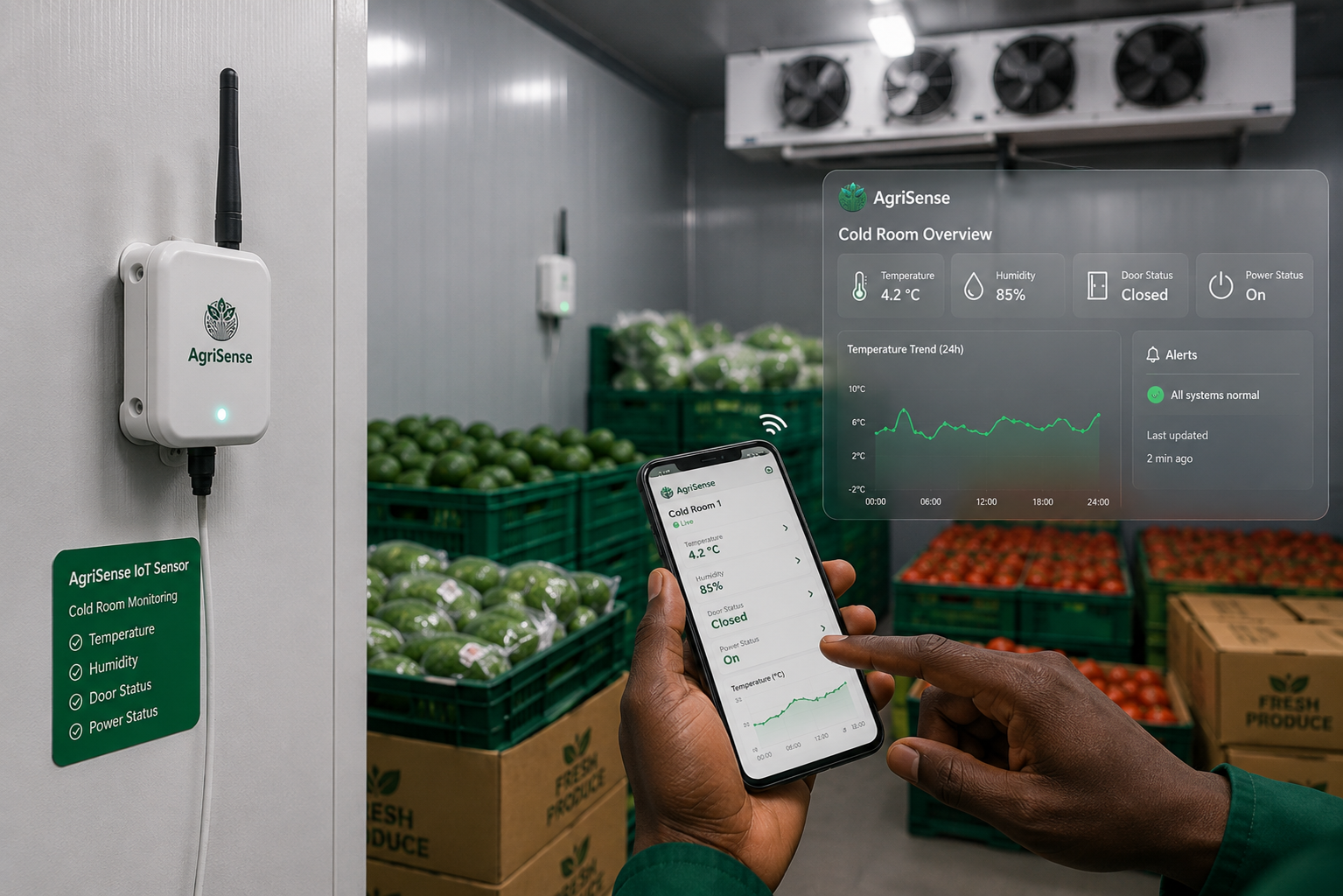
IoT sensors monitoring cold-chain produce

device-recorded where available Cold Chain

Rugged, self-powered sensors attach telemetry to every batch across a 7-stage consignment lifecycle — from the field to the export dock.
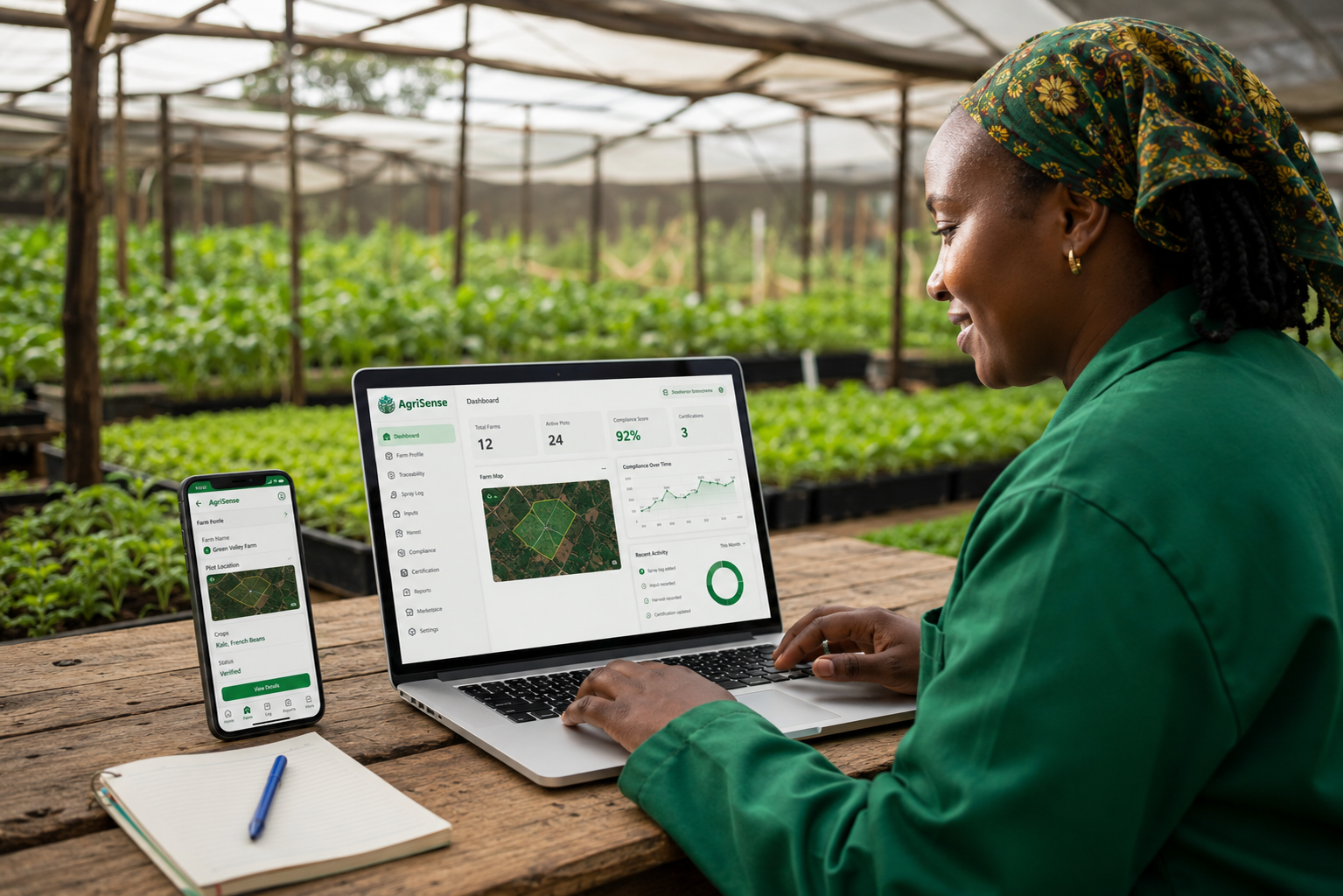
  • 7-stage lifecycle: AWAITING_PICKUP → INCOMING_BOOKING → IN_TRANSIT → STORED → DISPATCHED → DELIVERED → TRACEABILITY_ARCHIVE.
  • Advanced sensor network: Multi-parameter monitoring devices for temperature, humidity, location tracking, and environmental conditions.
  • Key metrics: Tracks thermal exposure, handling time, and remaining shelf life using industry-standard approaches.
  • Self-powered: Solar-powered with extended battery backup; multiple connectivity options with offline data storage.
  • Built for Africa: IP65 dust and water resistance; offline Bluetooth sync; ChirpStack gateway support.
AgriSense traceability certificate and buyer verification dashboard

Traceability Reports & Buyer Verification

Every consignment generates a tamper-evident certificate with record-consistency hash, unique identifier, QR code, and public verification URL — verifiable by EU buyers without login.
  • Certificate contents: Farm GPS, 7-stage timeline, thermal history, spray compliance, carbon footprint, and buyer evidence status.
  • Buyer portal: Verify at agrisense.nexus.leniumsolar.com/verify.
  • Four-tier lookup: Hash exact match, batch_id match, consignment_id match, AGS- prefix scan.
  • Hash-chained integrity: record-consistency-linked audit ledger — any modification breaks the chain.
  • Export-ready reports: 11-section HTML dossier with embedded base64 logos, QR, and digital signature.
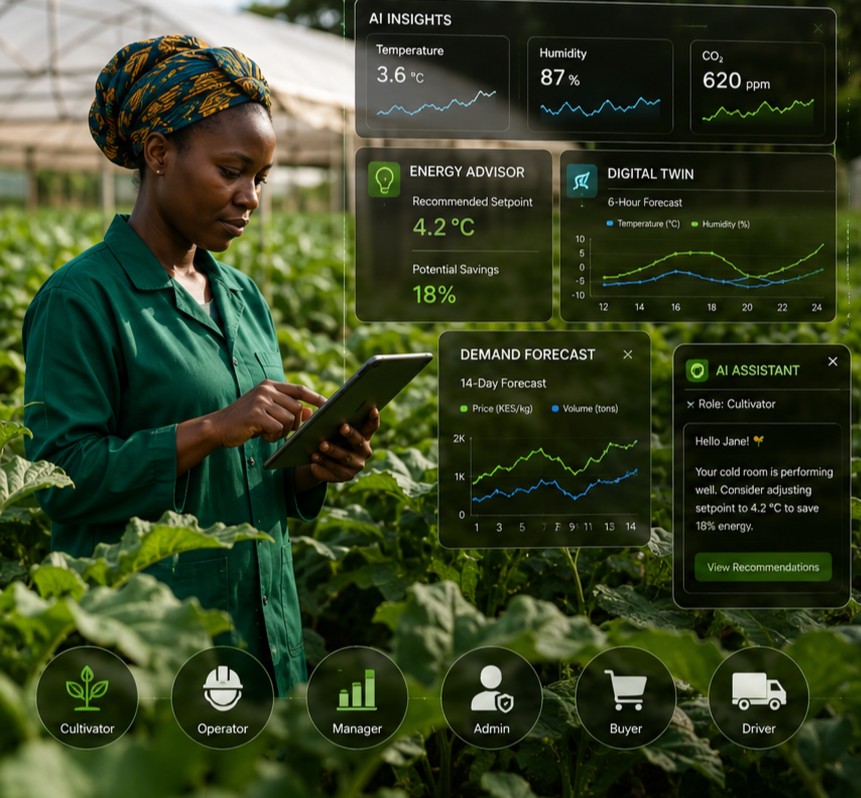
AI & Machine Learning - Cold Room Sensors

AI & Machine Learning

Dual-tier models deliver predictions offline and online, with a role-aware AI assistant for every user.
  • Dual-tier RSL: Lightweight Q10 physics model offline; 39-feature ML model online.
  • Digital Twin: 6-hour temperature/humidity forecasts with confidence intervals.
  • Energy Advisor: Setpoint recommendations to reduce cold chain energy use.
  • Demand Forecasting: 14-day price and volume forecasts by produce and county.
  • FloatingAIBot: Draggable, role-aware AI assistant with stats panels and proactive insights for cultivators, operators, managers, admins, and buyers.
Multi-Role Platform - User Roles

Multi-Role, Offline-First Platform

Six roles share one verified data layer, with offline sync, PWA capabilities, and multi-language support.

  • Core roles: Cultivator, Operator (supervisor, driver, technician), Manager, Admin, Buyer, and Driver.
  • Offline-first: AsyncStorage caching, operation outbox, IndexedDB queue, and Bluetooth sensor sync.
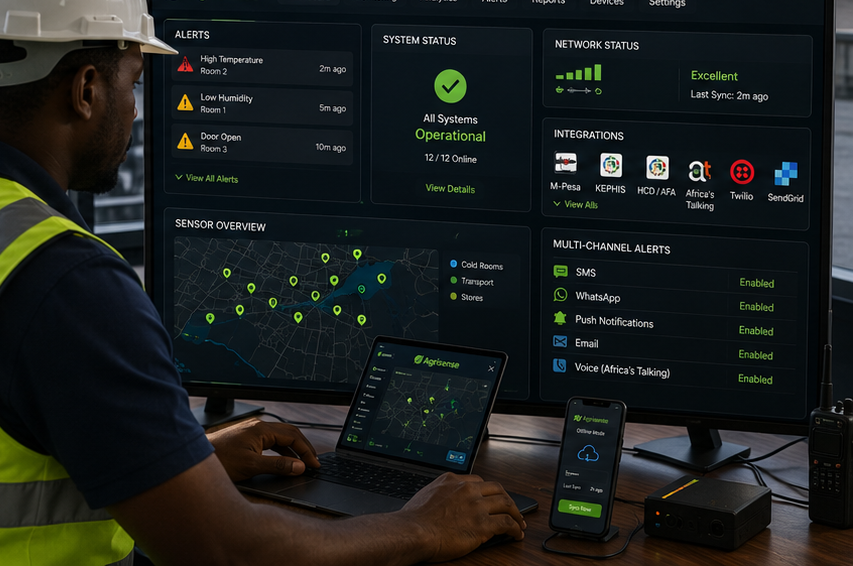
  • Multi-channel alerts: SMS, WhatsApp, push, email, and voice via Africa's Talking and Twilio.
  • Multi-language: English, Swahili, Kikuyu; extensible to French, Arabic, and Spanish.
  • Integrations: M-Pesa, KEPHIS, HCD/AFA, KRA iCMS, Africa's Talking, Twilio, SendGrid, InfluxDB, Firebase, and EU TRACES NT.
EVIDENCE HIERARCHY

Show what kind of proof you have.

Declared

A grower or handler states it. Useful context, but not independent proof.

Documented

A receipt, logbook, photo or certificate attachment exists and can be inspected.

Validated to issued

Consistency checks, devices, partners and authorities can add progressively stronger evidence.

RECORD INTEGRITY

A lot report explains its own limits.

A traceability report can display the lot number, origin, custody events, evidence attachments, confidence level and data-access permissions. It should also state clearly when a map is a placeholder, a reading is missing or a document is provided by a participant rather than an authority.

Illustrative reports are not certificates of compliance.

ASSISTED REVIEW

Flag a question; do not manufacture an answer.

Available as a priced option

The pricing schedule includes AI-assisted pest/disease flags at KES 5 per assessment. It is an assisted review signal, not a diagnosis or regulatory conclusion.

Human evidence still matters

Photographs, laboratory or agronomist records and buyer requirements remain attached as their own evidence types.

EXCEPTIONS

Make an exception visible before it becomes a dispute.

Detect

Record a quantity variance, missing handoff or temperature exception against the relevant lot.

Notify

Use the agreed workflow to bring the question to the responsible grower, handler or partner.

Resolve

Attach the explanation or supporting record. The trail should show what changed and why.

BUYER ASSURANCE

Give buyers the record they need — and no more.

QR lot view

Consumer QR and buyer lot-passport scans are included without a per-scan charge.

Evidence dossier

An automated evidence dossier is listed at KES 150; re-exports are listed at KES 30.

Permissioned access

Partner grants, CSV exports and APIs are priced separately and can be selected in a scope.

Buyer Evidence Requirements, Built In

The EU Deforestation Regulation requires proof of geolocation, deforestation-free status, and chain-of-custody for imported commodities. AgriSense already captures all three.

GPS Polygons

Farm plot boundaries captured and linked to every batch and certificate

Deforestation-Free

Due diligence statement generated from land-use data and date of production

Chain-of-Custody

Hash-chained ledger proves every handoff from farm to export point

What buyer evidence Means for African Exporters

From 30 December 2025, EU importers must have due diligence records for all fresh produce. Without GPS polygons and deforestation-free evidence, shipments can be blocked at EU ports. AgriSense turns this regulatory burden into a competitive advantage: every batch already carries the proof EU buyers need, so African exporters can sell faster, with fewer rejections, and at premium prices.

Talk to Our buyer evidence Team

Built for Every Role, Every Country

AgriSense brings a shared lot view to the people who create, handle and review records. It is being shaped around Kenyan supply chains, with a practical foundation for partners working across markets.

Five Core Roles

Each role sees only the data and actions it needs, while the underlying ledger stays shared and verified.

  • Cultivator: Spray logs, PHI countdown, harvest records, and Traceability Reports.
  • Operator: Supervisor, driver, and technician views for cold rooms, trucks, and sensors.
  • Manager: Fleet, facility, and outgrower dashboards with compliance KPIs.
  • Admin: Cooperative, exporter, and program-level configuration and reporting.
  • Buyer: Public certificate verification and shipment-level due diligence.

Multi-Country by Design

Kenya is the reference market with 47 counties mapped. The platform is designed to extend across Africa, Asia, and Latin America.

  • Reference market: Kenya with 47 counties, KEPHIS, HCD, PCPB, KRA integrations.
  • Extension protocol: Tanzania, Uganda, Ethiopia, Ghana, India, Vietnam, Peru.
  • Multi-language: English, Swahili, Kikuyu; extensible to French, Arabic, Spanish.
  • Offline-first: AsyncStorage, operation outbox, and USSD fallback for low-connectivity areas.
  • Local payments: M-Pesa integration with support for additional mobile money rails.
WHO USES THE TRAIL

One lot. Four useful views.

The same lot can answer a different practical question for every person who handles it. AgriSense keeps those questions connected to one shared record.

01 / GROUP RECORD

Cooperative chairperson

See what members delivered, where a lot came from and which records support the group’s handover.

  • Shared lot records for collection and aggregation
  • Member delivery and contribution history
  • QR-linked lot summaries for the receiving party
  • A clearer basis for resolving record questions
Discuss a cooperative workflow
02 / HANDLING VIEW

Pack house or cold-store operator

Keep receiving, grading, packing and dispatch records tied to the lots your team actually handles.

  • Incoming, grade and packing handoff records
  • Lot splits, mixes, quantities and custody notes
  • Existing condition logs and handling documents, where used
  • A concise handover view for the next operator
Discuss a handling workflow
03 / SHIPMENT VIEW

Exporter or buyer-facing team

Bring source records and shipment handoffs into one place when a buyer asks for context.

  • Trace a buyer question back toward the source lot
  • Prepare a structured evidence summary for review
  • See which expected records are present or still missing
  • Coordinate follow-up across growers, handlers and buyers
Discuss a shipment workflow
04 / REVIEW VIEW

Buyer or assurance reviewer

Read the history supplied for a lot without having to reconstruct it from calls, messages and separate files.

  • Review origin, custody and supporting records together
  • See the stated evidence status for each relevant item
  • Use a clear lot report as the starting point for review
  • Send a focused follow-up question to the supplying team
Explore buyer assurance
WHAT WE MEASURE

Metrics belong beside the record.

AgriSense is designed to make operational performance inspectable, not merely reportable. The figures below are planning targets and illustrative assumptions—not published results.

Targetplanned performance to validate Measuredreserved for released pilot data
Target 98.5% temperature-record completeness across enrolled monitored assets
Target 85%+ record-prediction accuracy target, subject to product-model confirmation
Target 30%+ post-harvest loss reduction to test against a measured baseline
Target 10–20% energy-saving range to assess where monitored handling equipment is in scope
THE VALUE LEDGER

Measure the operational and commercial picture together.

These are the measures a cooperative, handling partner or buyer can agree before a deployment. Market-price and fee ranges below are planning assumptions that need a crop- and route-specific source before public use.

01

Operational record

  • Lot coverage: share of handled volume with a usable lot identity
  • Custody continuity: handoffs recorded against the intended route
  • Evidence completeness: expected items present, missing or awaiting follow-up
  • Quantity reconciliation: input, output, split and mixed-lot balances
02

Commercial measures

  • Illustrative KES 320–520/kg: avocado Grade A versus Grade C price range; source required
  • Illustrative KES 45,000–120,000: audit-revisit cost range per cooperative; source required
  • Target 3.2×: package return target to be assessed against actual cost and benefit
  • Target 8–12%: rejection-rate range to reduce where a verified baseline exists
03

People & resource measures

  • Target 45%: women-participation target for relevant programme activity
  • Food loss: kilograms recorded as spoiled, recovered or redirected by lot
  • Skills: operators trained and records completed without follow-up
  • Energy: kWh recorded before and after a defined handling change
ILLUSTRATIVE LOT SCENARIO

What a before-and-after record could show.

This is a worked example, not a customer case study or performance claim. It demonstrates the inputs a team could measure during a season.

Illustrative only

Avocado route: farm → collection → pack house → buyer review

A cooperative chooses one route and compares the records it held at the start of the season with the records it can assemble after introducing a lot-level workflow.

2,000 kgseasonal volume entered
35% → 15%loss-rate scenario
KES 60 → 120/kgprice scenario, source required
3.2×return scenario, not measured

Before: disconnected information

  • 2,000 kg planned volume; 700 kg recorded as spoilage in the scenario
  • Field, handling and buyer records kept separately
  • Buyer questions trigger manual calls and document searches

After: a measured lot trail

  • Loss, handoff and evidence completeness measured against the same lot
  • Receiving team reviews a structured record before asking follow-up questions
  • Commercial outcome recorded only where a signed buyer record supports it
OUTCOME MEASUREMENT

Make the method visible before the result.

AgriSense can organise the records needed to calculate these measures. Independent methods, crop factors and partner approval remain necessary before any carbon, ESG or impact result is published.

MeasureUnitRecord sourceHow it is read
Food loss avoidedkg / seasonLot quantity, condition and final disposition recordsCompare a defined baseline with the observed route
Emissions avoidedtCO₂e / seasonFood loss result × crop-specific factorUse a named, approved methodology—not a platform default
Energy changekWh / periodMeter or equipment logs where availableCompare equivalent periods and operating conditions
Route distance documentedkm / lotRecorded pickup, delivery and handoff locationsSum only the route events supported by records
Traceability coverage% of lots or volumeLots with a usable identity and linked handoffsReport the denominator beside the percentage

Measured will appear only beside released pilot data with an agreed scope, source and method. Until then, targets and illustrative calculations remain visibly distinct.

Technical Specifications

Built for African connectivity: mobile-first, offline-capable, and powered by a cloud-native stack that scales from one farm to multi-country networks.

Hardware & Sensors

  • Temperature monitoring: Wide range sensors with high accuracy for precise cold chain tracking
  • Humidity tracking: Continuous monitoring to prevent moisture-related spoilage
  • Door sensors & GPS: Track facility access and shipment location in real-time
  • Solar-powered: 30-day battery backup with solar charging for remote locations
  • Offline sync: Bluetooth connectivity for areas with limited network coverage

Software & Platform

  • Mobile-first design: Works on smartphones with offline capabilities
  • Multi-language support: English, Swahili, Kikuyu with extensible language options
  • Cloud infrastructure: Scalable backend with 99.9% uptime target
  • Real-time sync: WebSocket technology for live updates and alerts
  • API integrations: Connects with payment systems, regulatory bodies, and export platforms
LOSS-RECOVERY ESTIMATOR

Put one route into the picture.

Enter the best figures you have for one crop and route. The estimator turns a change in loss into a cautious recovery range you can discuss with your team.

STEP 1 / ENTER YOUR STARTING POINT

Work from the records you have today.

Use a seasonal volume, your current loss estimate, a realistic working target and the price you receive per kilogram. You can change any field—the range updates immediately.

STEP 2 / READ THE RANGE

Potential recovery if the target is reached.

The range allows for uncertainty around the loss reduction. It is designed for planning, not as a promise of outcome.

Produce retained 680–920 kg kilograms that could remain saleable
Potential value KES 54,400–73,600 based on your price input
8 percentage points

is the reduction between your current loss and working target.

PRICING & DELIVERY

Start free. Pay for the records, tools and help you use.

All prices are KES, exclude VAT where applicable and remain subject to final quotation and contractual scope.

  1. 01 Choose accessStart with the operating level that fits the route.
  2. 02 Add the records usedUsage is visible by record, lot and dossier activity.
  3. 03 Bring in support when neededHardware and delivery are scoped to the work.
SUBSCRIPTION ACCESS

Choose the operating level for your route.

Move from a named farm record to multi-site reporting without paying for functions that are not yet in scope.

START HERE

Freemium

For an individual farmer beginning one clear record.

KES 0/year
  • Basic profile
  • One crop record
  • Manual logging
COOPERATIVE

Basic

For a small cooperative building a shared trail.

KES 1,500/month

KES 18,000/year

  • Registry and QR lots
  • Receiving records
  • Delivery records
MULTI-SITE

Institutional

For teams coordinating several operating locations.

KES 12,000/month

KES 144,000/year

  • Multi-site reporting
  • Integration capability
TAILORED

Enterprise

For tailored operating workflows and agreed service levels.

From KES 25,000/month

From KES 300,000/year

  • Tailored workflows
  • Analytics
  • Agreed service levels
USE, EQUIP & DELIVER

Only add the parts your route needs.

Subscription access is the base. Record activity, equipment and professional delivery are shown separately so the scope stays clear.

PAY AS USED

Digital usage

Origin passport
KES 40
Harvest lot
KES 3
Lot QR
KES 5
Handoff
KES 2
Mass balance
KES 8
Automated dossier
KES 150
WHEN NEEDED

Optional hardware

  • GPS deviceKES 6,500
  • QR scannerKES 4,500
  • Weighing scaleKES 7,000

Sensors, cold-room kits and trackers are quoted when needed.

SCOPED SUPPORT

Professional delivery

  • DiscoveryKES 15,000
  • Core Traceable-Lot Pilot
    About 60 days · 5–10 lots
    KES 300,000–450,000
  • Full Assurance PilotKES 450,000–700,000
BILLING EXAMPLE

See what makes up the bill.

The customer bill is the agreed subscription plus actual billable usage and any optional equipment or professional services.

Basic subscriptionKES 1,500
Production recordsKES 600
PHI SMS messagesKES 160
Illustrative monthly totalKES 2,260

Illustrative example: a Basic cooperative with 40 farmers and two PHI SMS messages each per month. Taxes and optional services are excluded.

AgriSense Development Timeline

Key milestones and future targets for our agricultural traceability platform

Dec 2024

Application & Acceptance

Applied to and was accepted into Jacob's Ladder Africa's GreenLabs incubation program, marking the formal start of AgriSense development.

Jan - Nov 2025

GreenLabs Incubation

Intensive 11-month incubation program with mentorship, technical support, and validation of the AgriSense vision and methodology.

Late 2025

MVP Development

Transitioning AgriSense from Proof of Concept to Minimum Viable Product through data collaborations with industry partners and pilot deployments.

2026 (Target)

Kenya Scale

Target: Deploy AgriSense across Kenya with agricultural distributors and expand to East Africa.

Start Issuing Traceability Reports in 4 Weeks

No complex setup. From order to your first buyer-verifiable certificate in under one month.

Week 1

Order & Ship

Choose your package, pay via M-Pesa or bank transfer, and devices ship the next business day.

Week 2

Register & Map

Our technician captures farmer identity, GPS plot boundaries, and installs sensors. Your first batch is registered in the ledger.

Week 3

First Certificate

Generate your first traceability certificate with QR code and record-consistency hash. Share it with buyers or cooperatives.

Week 4

Review & Scale

Review first traceability results, loss reduction, and buyer feedback. Add more batches, sensors, or buyer evidence features as you grow.

Product Roadmap

Our scaling plan for AgriSense across Kenya and East Africa over the next 24 months.

Q1-Q2 2026: MVP Launch

  • Commercial Launch: AgriSense platform goes live with 50 pilot customers
  • Consignment Certificate PDF: Branded, QR-verified traceability certificate with thermal charts
  • Buyer Verification Endpoint: Public web page to verify certificate hash authenticity
  • buyer evidence Module: Farm GPS + chain-of-custody export for EU Deforestation Regulation
  • Mobile Apps: iOS and Android applications in English and Swahili
  • Partnership Expansion: 5 additional distributor and exporter partnerships

Q3-Q4 2026: Scale Acceleration

  • Geographic Expansion: Operations in 10 Kenyan counties
  • Buyer Portal: Web dashboard for EU/UK buyers to view incoming consignment traceability data
  • Customer Base: Target 500 active farming operations using AgriSense
  • Technology Enhancement: Advanced analytics dashboard with predictive insights
  • Partnership Network: 20 agricultural distributors, cooperatives, and exporters
  • Revenue Target: KSh 25M monthly recurring revenue + per-certificate fees

2027: Regional Expansion

  • East Africa Launch: Tanzania and Uganda market entry
  • Enterprise Focus: Large-scale agricultural operations and processors
  • Technology Evolution: Computer vision integration for quality assessment
  • Strategic Partnerships: Collaborations with international development organizations
  • Impact Milestone: 10,000 farmers benefiting from AgriSense technology

2028: Continental Vision

  • Pan-African Presence: Operations in 10 African countries
  • Technology Licensing: Platform licensing to local partners
  • Research Leadership: Agricultural technology R&D center in Nairobi
  • Policy Influence: Government partnerships for national food security initiatives
  • Sustainability Impact: 1 million tons of food waste prevented annually
DATA AND PERMISSION

Record only what the route needs.

Data principles

  • Agree the traceability purpose before collection.
  • Use appropriate consent or another lawful basis for personal data.
  • Limit access to the people and partners allowed for that purpose.
  • Document pilot data handling in line with Kenya Data Protection Act principles.

Commercial clarity

  • No compulsory hardware: manual, smartphone and existing-record workflows can start first.
  • Devices, travel, installation, taxes, integrations and formal pilot work are quoted separately.
  • Operational forms and evidence dossiers are digital-first, not proof of independent accreditation.
FAQ

Questions partners ask before a pilot.

Does AgriSense replace KEPHIS or AFA inspections?

No. It supports clearer lot records; it does not replace any authority system, inspection or official certificate.

What happens to data I enter?

Data is used only for the agreed traceability purpose, with access and handling documented before pilot onboarding.

Does it work offline or without a smartphone?

The workflow is confirmed per pilot. Manual records, field support and existing documentation can be part of the agreed operating model.

What does a pilot cost?

Pilot cost is agreed after scope. A Core Traceable-Lot Pilot ranges from KES 300,000–450,000; a broader Full Assurance Pilot ranges from KES 450,000–700,000. Tax and optional equipment are agreed before purchase.

Start with one lot.

Pick one crop, one buyer and one route. We will show the full record trail in a pilot before asking you to commit to anything larger.